The next day, I showed up to view her again. Before I left, I told Joe I wanted her. The next day, I arrived with my son, a friend’s auto transport hitched to my Dodge diesel, and five crisp one hundred dollar bills American in my shirt pocket. After volunteering some of Joe’s neighbors, it took the five of us men to load this truck for transport back to my house.

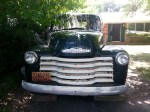
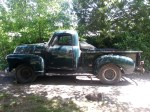
My son and I unloaded the truck by ourselves fairly easily into our driveway. The next day, I took stock of the purchase I had just made. In the three years since the tree accident, sitting neglected under a leaky tarp, water puddling in the massive dent in the roof had rusted it through, soaked the floor and all of the mice and squirrels’ nests packed tightly under and behind the seat and under the gas tank.
Rust. Uggg, not rust! I started to panic, but settled down once I’d got into it, realizing it was only deep surface rust. Not good, and still a lot of work to save the metal, but a site better than rusted through. I caught all this mess, I might add, not a moment too soon. In fact, at many more junctures breathing life back into this old girl, it became clear how close the world had come to losing yet another proud relic of our coveted, once respected, now-lost-forever American industrial and manufacturing might. At so many turns in her restoration, I am acutely aware that I have become the restorer of yet another lost cause.
Joe and his family had given up on her out of frustration, as well as from a lack of both skill and inspiration. Kids now gone, life goals redefined, squirrels and mice as squatters in an old ailing Chevy, life for this couple had become complicated and needed simplifying.

My first task of starting the engine took about a week and a half of poring over the original Chevy shop manual, much head scratching, and systematically replacing battery and leads, then one by one, other electrical leads, each getting me closer to her running. The magic moment of inspiration actually grew out of frustration, then desperation, one hot summer day. Convinced I had tried everything, my daughter’s suggestion to type “antique Chevy no spark” into Google led me to a forum where I found the answer. After bypassing the ignition wiring with good wire, the old Chevy burst to life, settling down into a gentle purr. The problem was a bad ignition wire from the coil to the points.

Now, before readers take me to task for driving the old girl around my yard without first cleaning the tank of old gas and the sticky varnish created as it distills itself over time, fuel lines, carburetor, and related parts, as well, bear with me as I tell my tale of woe, then where what may appear as my foolhardiness led me. It wasn’t long before the Chevy’s purring turned into roughness, coughing, and gasping for breath and RPMs. She died sputtering conveniently in the back yard.
I checked with Larry at my local machine shop. His tales of the catastrophic, costly damage to engines caused by spoiled modern gas gumming up the works were more than I could process. I felt stupid.
I listened to the tale of another customer who’d had Larry rebuild a BMW engine, years ago. The engine finally back together, the man started her up. She ran like a clock, that is, until the old, nasty gas he hadn’t cleaned out of the tank gummed up this brand-new engine, in the end, bending push rods, literally breaking rocker arms and bending rocker shafts. The engine was almost destroyed.
Another engine Larry rebuilt for still another man, that engine suffering even worse damage than the BMW, all because of old, spoiled gas.
Larry ended up rebuilding the BMW engine again, costing the owner considerably more than the original rebuild, expensive enough even then. In his thirty-years experience, even Larry wasn’t aware that modern gas could wreak such havoc. Apparently, old gas was not as bad. At any rate, I limped home dejected, convinced I had ruined the engine.
 Doren K. Weston