In those six months of Charlotte little more than an increasingly-expensive lawn ornament, recovering then from surgery number seven, waiting for parts and services, I attacked as much as could attack in my condition the issue of mouse and squirrel nests, then the rust.
I went through about two gallons of phosphoric acid etch solution treating the cab floor, top to bottom, cab walls, doors, frame, in fact, anywhere I saw the slightest evidence of rust. I am aggressive when it comes to the issue of attacking rust, the same aggressiveness with which I attack injustice and corruption, unfairness and double standards, oppression and our safe, determined, comfortable thinking.
Afterward, I applied liberal coats of Rustoleum rusty metal primer, then Rustoleum black as a top coat. Inside the cab, the floor, walls, the doors, got still another coat, this time of Sherwin-Williams satin, another rust inhibitor, in the stock interior Chevy gray. Actually, the interior Chevy color is more somewhere between a champagne and brown, but I will leave that detail as a finishing touch. My Chevy supplier has this color in stock. This at least gets me on the road.
In the two weeks after bringing her home, but before my surgery, I built a bridge out of 2x8s, resting each end upon cinder blocks stacked outside on the ground. I didn’t want to force this old floor to support the weight of what I was about to do. Upon this bridge, I placed my small hydraulic jack and, with the aid of various lengths of 2x4s set between the jack and the roof, after much repositioning and trial and error, managed to push the cab’s roof dent back close to the original. The top is still a little wavy, but unless someone is extremely tall and knows what to look for, he cannot tell.
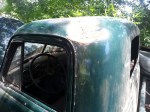


Using body filler to repair the rusted holes in roof, I smoothed and sanded to my satisfaction, then painted it with the original Forester Green. Eventually, I will replace the top with a factory replacement from my Chevy supplier, but for now this patch works and is passable, and it gets me on the road.
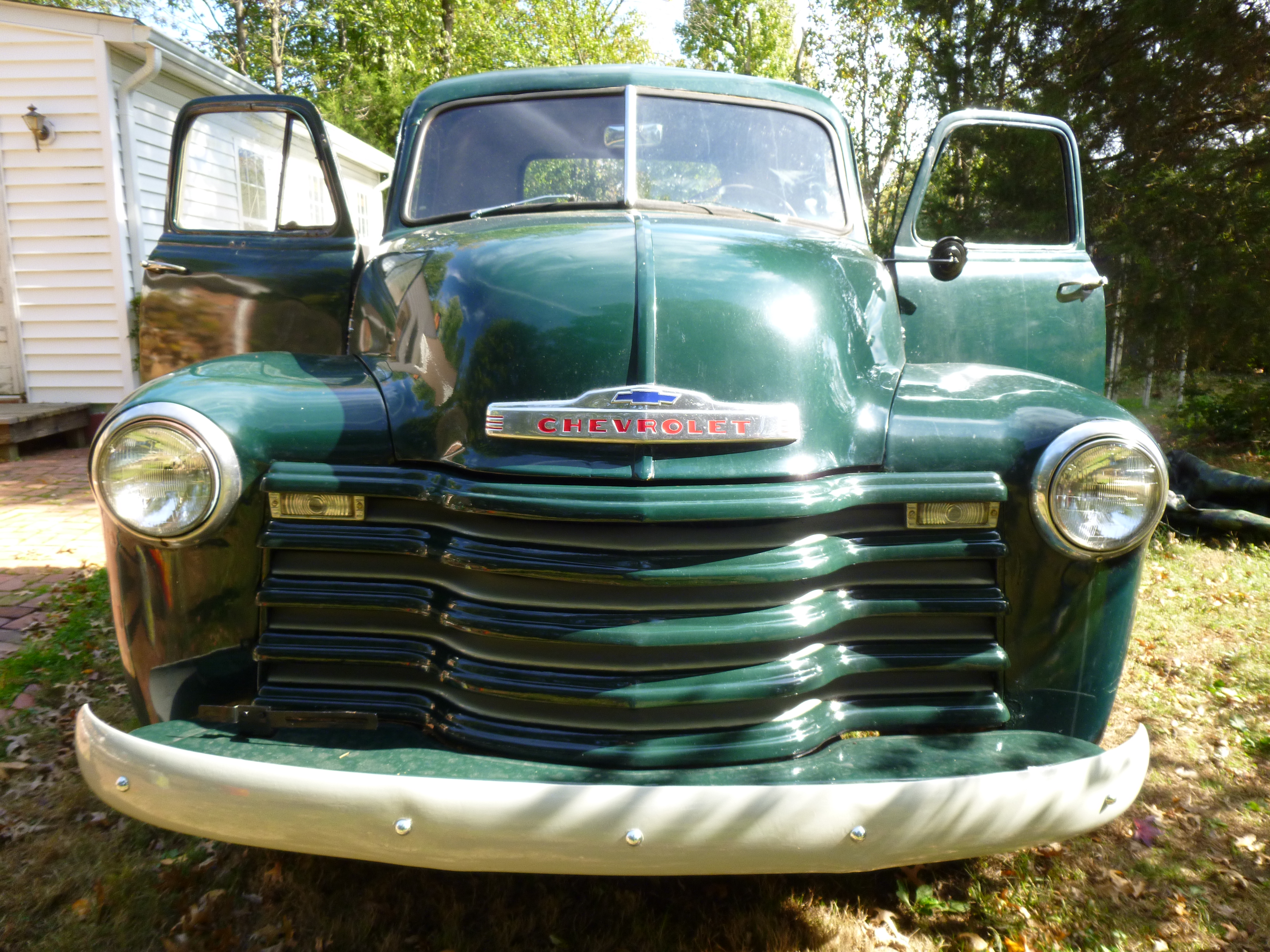
Now, on this Chevy truck, as is the case with most vehicles from that bold, proud era, the defining characteristic of the breed is the grill. This era grill is made up of many pieces which are meant to be painted according to a different plan, the plan dependent upon the year truck.
In 1952 and 1953, America was fighting the war in Korea, a circumstance which rendered steel, copper, and chromium in short supply. The popular chrome grills and bumpers on these trucks then unavailable as an option, on the new models these parts had to wear paint instead. Chevy’s beautiful color it dubbed Thistle Gray was the color of choice.
I had ordered the paint, gathered supplies. I thought this would be a cinch, but before I could paint over the faded, rust-stained beige some previous owner had sprayed the entire grill, I had to remove it from the truck. Rusted bolts occupying places where my hands, much less a hack saw, could not fit, I finally invested in an angle grinder, a tool that has become my trusted ally in this project. This grinder made quick work of the bolts.

It took both my son and me to finally pry the grill from between the fenders. At least thirty bolts hold that grill in place. Once it was off and in my workshop, I realized yet one more time that I had saved this truck from oblivion just in the nick of time. The outer bars of this grill were passable, as were the inner bars, but the deep surface rust on the back side of the grill took days of scrubbing, wearing out many wire bushes, quarts of phosphoric acid etch, and several sliced fingers to set things to rights.


Then, coating every square inch of the back, sides, and the insides, as well, with Rustoleum rusty metal primer, I finished up with a thorough coat of satin black, also painting all of the sheet metal right up to the radiator. The grill has now been frozen in time. I had done it.
 Doren K. Weston