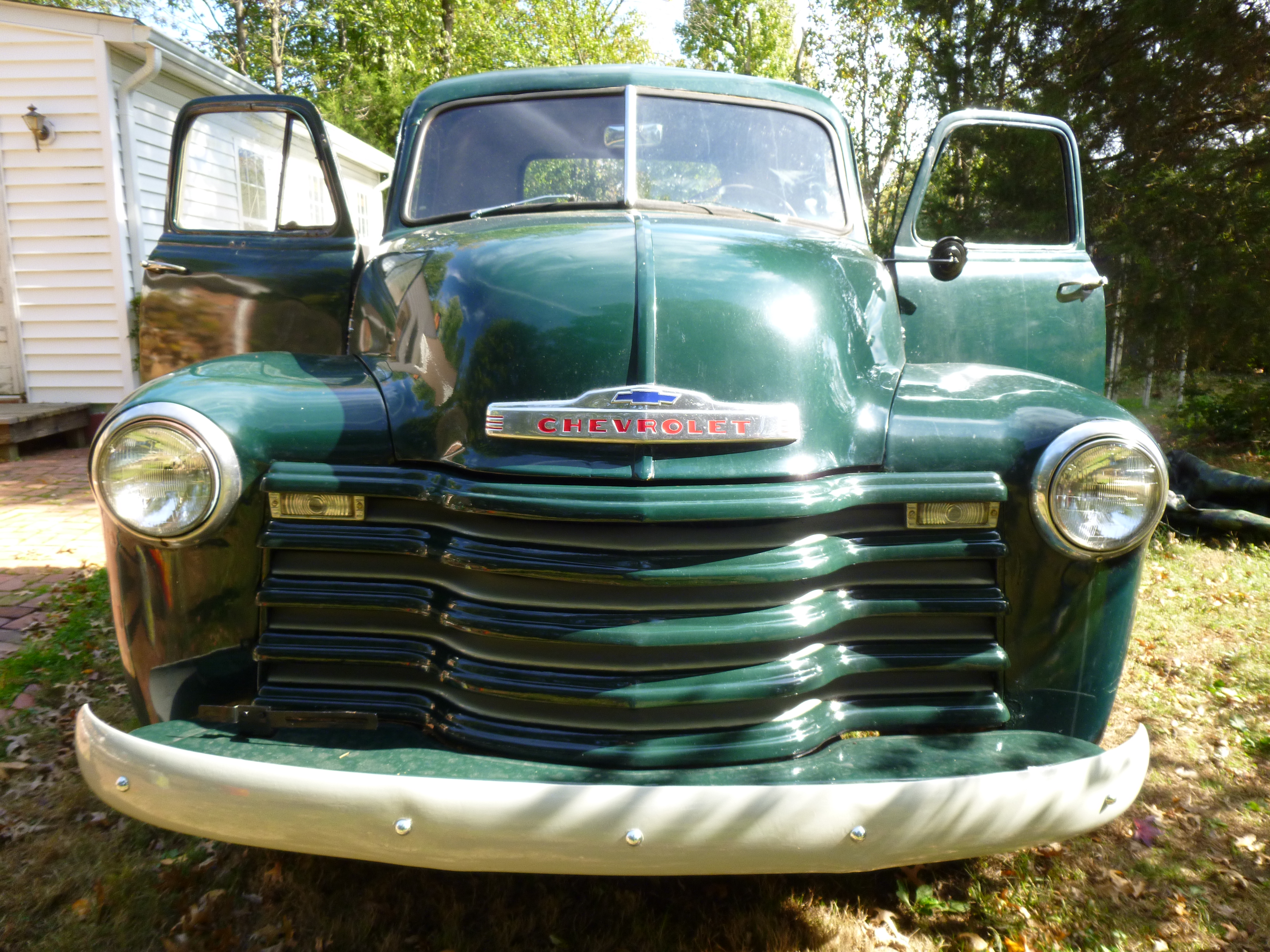
The real challenge became finishing the front side. In 1952, Chevy called for the outer bars of the grill to be the same color as the body, Forrester Green in this case. The inner bars are meant to be Thistle Gray.
This paint from my Chevy supplier is actual body paint. As such, it is meant to be sprayed, not brushed. Having no access to spray equipment, I thus had to develop a technique for brushing paint that is not at all forgiving. Furthermore, this paint is so toxic that no matter the size job, whenever I even open the paint can, I have to be wearing my 3-M respirator.
The outer bars of this grill took eight coats of Forrester Green before I was satisfied with the look. The inner bars with their Thistle Gray took three coats, which was not easy to apply with the grill assembled. Still, the Thistle Gray is slightly more forgiving, so that helped me in the end. As a finishing touch, Chevy specs also call for a 1/8 inch pinstripe in Cream color where the inner bars curve to meet the green of the outer bars, but that will have to wait.
All told, the restoration of the grill took around two weeks, not including repair to the sheet metal on one of the grill’s vertical supports on one side or the reinstallation of the grill. To reinstall the grill, I used stainless steel bolts
Once the grill had been resurrected, with my trusty angle grinder I smoothed the sloppy welds with which someone had graced the bumpers. Then, they each received five coats of Thistle Gray, then only after several coats of primer. I remounted the finished bumper using a kit of those specialized chrome bolts in that familiar bold, round-head Chevy bumper-bolt style.**
I have replaced brake lines and hoses, master cylinder, bushings, draining and refilling the transmission and rear end with gear oil, dismantling every leaf spring and its respective grease fitting, literally digging out the sixty-three-year-old grease, then filling with new, rebuilding the shifter coupling, also digging out the original nasty, dry grease, repacking with new so she would shift, I have concluded that even though these trucks were designed for regular preventive maintenance, what most of them suffered over their lives was neglect because owners simply did not know or, more than likely, simply did not want to be bothered maintaining the vehicle. Sort of sounds like people today. I’m thinking that relationships have not changed as much as people are led or would like to believe.
The sixteen-year-old daughter of a man at my Chevy supplier was overheard exclaiming that she would love to own one of these old trucks. I said to him, “Oh, really? As the proud owner of one of these trucks, let me tell you how long your daughter’s interest in such a gift will last. It will last about fifteen minutes.
“Once she realizes how much work it is to drive one of these trucks, that she has to shift gears, by hand, herself, that first gear is not synchronized, meaning that she has to stop before putting it into gear, thus, no more California Rolls; once she realizes there is no air conditioning, CD player, or power steering, just a huge steering wheel instead, no power brakes, turn signals, or peppy acceleration, she will lose interest in the truck.”
I personally enjoy driving my Charlotte because she fits my personality. I was weaned on a 1963 Dodge pickup, also with three-on-the-tree shift, so driving Charlotte is like coming home. I tend to drive gently. I don’t speed nor am I reckless, and I stop at stop signs and red lights.
Every time we take to the road Charlotte receives stares of both wonder and curiosity, always a smile, and many a frequent thumbs up from gawkers who, in their passivity and their understandable ignorance, find Charlotte’s appeal only through her uniqueness, her refreshing breath from history, and the respite she gives people from their mundane lives. These onlookers have no idea what it takes to maintain her, even more so to drive her. Owning an antique vehicle is truly a labor of love.


 Doren K. Weston